

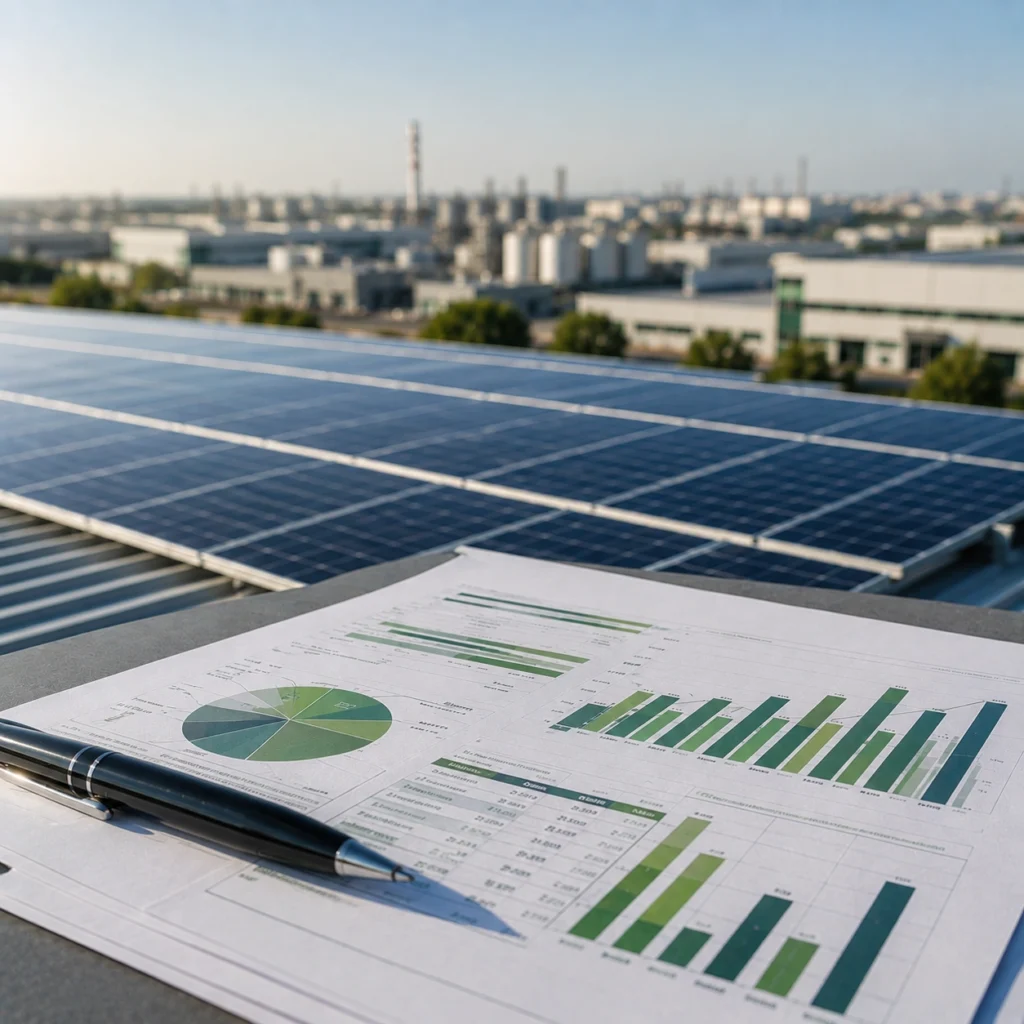
Most factories in Morocco that look at solar arrive at the same question: should we buy the plant, or only buy the electricity? That is the choice between turnkey EPC and a Zero-CapEx power purchase agreement (PPA). Both can cut a medium-voltage bill. They do not produce the same balance-sheet result, the same control, or the same rights under Law 82-21.
What turnkey EPC means
Under EPC, Green Taqa designs, procures, builds and commissions the photovoltaic plant on your site. You pay for the asset. You own it. From the first kWh, every kilowatt-hour you self-consume replaces a grid kWh, and any surplus you inject — up to 20% of annual production, at ANRE-regulated tariffs — is yours.
You also keep the tax and accounting treatment of an industrial asset: depreciation, and a capital item on the balance sheet. Typical payback for a well-sized C&I rooftop or ground-mount in Morocco is in the region of five years, with 20 years or more of production after that. You remain responsible for operations, or you contract O&M — Green Taqa’s target availability SLA is 95%.
What a Zero-CapEx PPA means
Under a PPA, Green Taqa finances, owns and operates the plant as an independent power producer. You sign a long-term contract to buy the solar electricity you consume, at a tariff that is fixed or indexed and, by design, below your current ONEE or distributor rate. There is no upfront capex. Your finance team does not put a power plant on the books.
The trade-off is simple. You do not own the surplus revenue under Law 82-21. You do not own the residual value of the plant after year 15 or 20. You are bound by the contract term, credit conditions and offtake rules. For groups that must preserve cash, or that cannot take a new asset onto the balance sheet this year, that trade-off is often the right one.
A practical way to decide
- If you have capital, a stable site, and want the full Law 82-21 surplus plus depreciation: start with EPC.
- If cash must stay in production lines, working capital or another investment: model a PPA first.
- If the roof or land tenure is short or uncertain: a PPA can be structured around the remaining lease, but EPC ownership is harder to justify.
- If your board wants a hedge against ONEE tariff reform (a full review is expected around 2027): both models hedge energy, but only EPC also builds an owned hedge.
What the numbers usually show
For a typical 1 MWp industrial plant in Morocco, Green Taqa’s reference case is about 1,580 MWh per year. Most of that value sits in self-consumption — replacing medium-voltage energy in peak and full-load hours, which is far more expensive than the ANRE buy-back of 0.18–0.21 MAD/kWh. Do not choose a model because of surplus sales. Choose it because of who owns the self-consumed kWh and who funds the array.
Ask for both term sheets on the same consumption data. A free pre-feasibility study is enough to see which structure improves EBITDA faster in your case.
Talk to Green Taqa
Green Taqa is a C&I solar PV developer and independent power producer based in Casablanca. We deliver turnkey EPC and Zero-CapEx PPA solutions, with a complimentary pre-feasibility study based on your actual electricity bills. No obligation.
Contact: +212 5 21 56 26 00 · info@greentaqa.energy · greentaqa.energy